Proportions When Drawing the Human Body
- Home
- Effigy Drawing
- Figure Drawing Proportions
7 Figure Cartoon Proportions to Know
Throughout the ages, artists take been fascinated by the claiming of depicting accurate proportions of the human body.
In that location have been countless attempts to standardize figure drawing proportions and lay down proportional rules to follow when depicting the torso.
Withal, observing how many systems of measuring proportions exist (or "canons" equally they are chosen) should be our first indication of how open up to interpretation proportions are, and that perchance no single proportional organisation tin be consistently accurate.
What exactly are proportions?
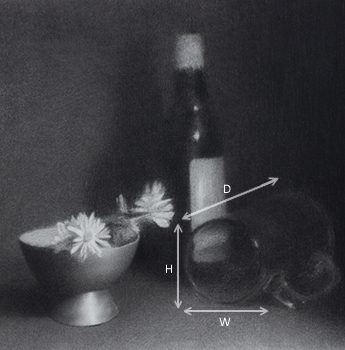
Proportions are the relationships, or ratios,
betwixt theheights, widths and depths of a subject.
In order to describe a believable likeness of whatsoever subject, no thing what or who it is, we must draw the proportional relationships as they appear on that specific subject area.
For example, in the drawing to the right, the height and width of the opening of the mug are fairly equal, while the depth is about a width and a half. These are the proportions specific to this mug in this detail scenario.
What would happen if I contradistinct these proportions? The drawn mug wouldn't quite resemble the mug I was observing, but it could still look conceivable and convincing.
In the case of a figure or portrait, however, accidentally altering proportions tin create very noticeable distortions that detract from the believability of your drawing. Minor inaccuracies in effigy cartoon proportions decrease the likeness of your drawing, while major inaccuracies may disrupt the logic of the body and cause it to expect anatomically inaccurate.
It's no wonder that artists throughout the ages accept tried to standardize these measurements! Information technology would certainly be convenient to be able to rely on a memorized proportional system … but can nosotros really rely on ane of these systems no matter who we describe? To answer this question, let'southward look at a brief history of proportional canons.
A Brief History of Proportional Canons
Every catechism (organisation of measuring proportions) is a search for a certain platonic of beauty. However, as the idea of beauty is so subjective, fluid and e'er-irresolute, and then have the canons been throughout history.
For example, the historic Greek canon created by Polycleitus defined a strong, male athlete who excelled at gymnastics and in the handling of weapons.
A typical example of this catechism is the Doryphoros, which is 1 of the best known sculptures of the Classical Era.
Withal, just equally today at that place are few bodies that fit into electric current ideas of the "platonic" body, it is likely that few bodies in Polycleitus' day fit the "platonic" body blazon of the Doryphoros as well.
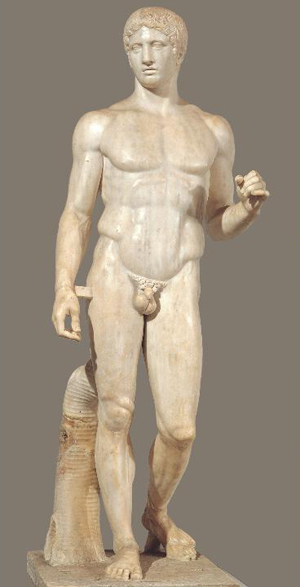 Roman copy of the Doryphoros
Another goal of canons is to establish a unit of measurement to divide the body into more manageable, measurable sections that would establish these "ideal" proportions. For example, in the oldest known text on proportion, which was an Egyptian canon, the length of the heart finger was chosen as the unit of measurement. It was thought to be equal to one nineteenth of the total height of the trunk.
In the Greek canon by Polycleitus, the palm of the hand was chosen as the unit of measurement.
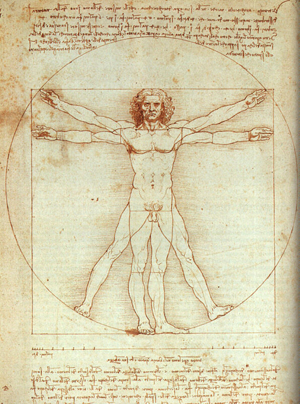
Marcus Vitruvius, a first-century BC Roman architect and writer, believed that the height of the figure was eight heads, or x faces.
Leonardo da Vinci demonstrated many of Vitruvius' ideas on proportion in the well known image of the human being in two superimposed positions inscribed in a square and circle: the "Vitruvian man".
Proportional Canons of the Nowadays Day
Equally yous may have guessed, the search for a perfect measuring system is rather pointless. There is and so much variation in bodies among individuals that it is impossible for anybody to fit into whatsoever set of standards. The unique qualities of each individual are part of the claiming, complexity and fascination of depicting the figure. However:
Knowledge of a few general proportions can be helpful to our drawings if we
utilise this cognition in combination with a sensitive ascertainment of the model.
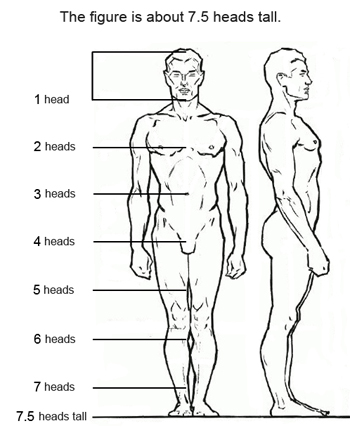
Today the most common unit of measurement is the head of the effigy, and t he figure is mostly idea to be between 7.5 and viii heads tall. ( The head is also a great place to brainstorm a effigy drawing, which yous can read about in the five Ways to Start a Figure Drawing article.)
What difference does 7.5 and eight heads make?
The 8 head alpine figure volition have considerably longer legs, such every bit those of a runway model or heroic action figure. A more realistic figure is approximately vii.5 heads tall, though as I volition continue to betoken out throughout this article, these are generalizations and should non be accepted as rules.
7 Effigy Drawing Proportions to Know
Before delving into the figure drawing proportions that I find near useful to remember, please note that these proportions refer to a standing figure. When the effigy leans toward or away from you, or sits or lies down, measurements become more complicated and sometimes obscured, and will often no longer autumn into the proportions listed beneath.
F R Due east Due east D O Westward Due north 50 O A D
At the end of this commodity, get a gratuitous Effigy Drawing Proportions to Know Infographic to utilize equally a reminder of these bones proportions !
In a standing position, seven figure drawing proportions to keep in mind are:
ane. The figure is approximately 7.5 heads tall.
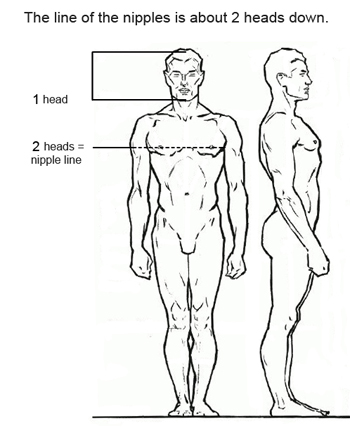
ii. About two heads downwardly from the top of the figure is the line of the nipples.
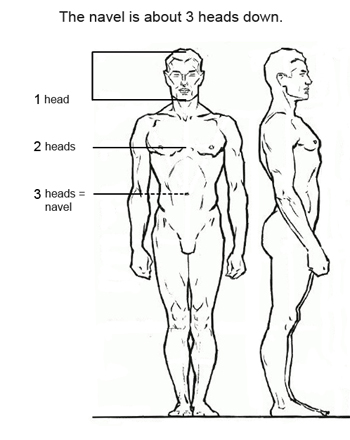
3. About three heads downwardly from the meridian of the effigy is the navel, or umbilicus.
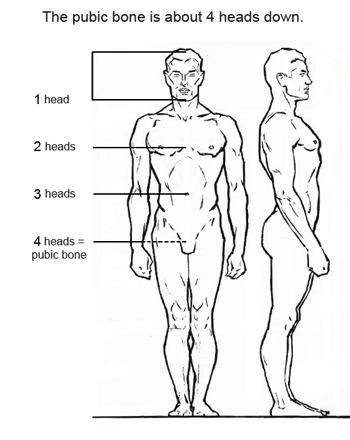
4. Virtually 4 heads down from the top of the figure is the pubic bone.
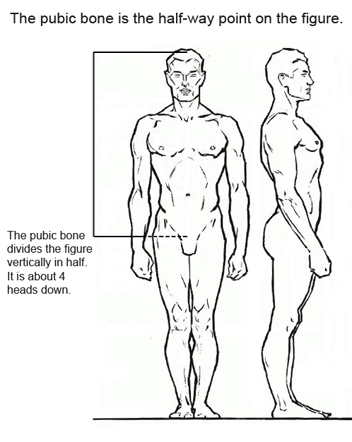
5. The pubic os is approximately the half-way signal on the trunk.
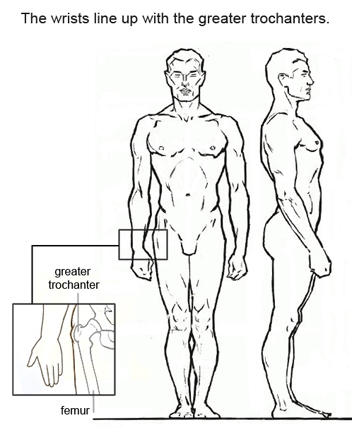
vi. The wrists line up with the greater trochanters of the femurs (upper leg os).
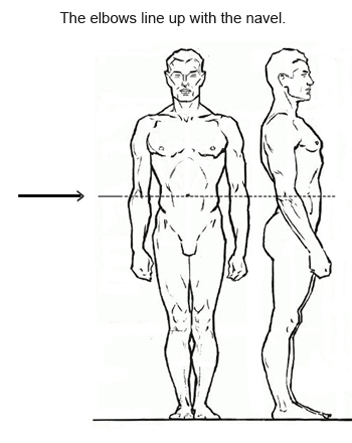
7. The elbows line upward with the navel (abdomen button).
Pros and Cons
of Using Proportional Systems:
Cons:
- relying heavily on memorized proportions tin can pb you lot to become lazy in observing the model, which can result in generic drawings
- because at that place is so much variation in torso types, no proportional system tin be accepted as a "dominion"
Pros:
- a proportional system gives you lot a general reference guide for assessing the relative lengths and widths of the body
- proportions can pb to more accurate and convincing drawings if they are used to compare to the proportions on the model
- memorizing certain figure cartoon proportions can greatly help you lot describe from memory and imagination
- memorizing proportions tin assist y'all design figures – for example, an animator may intentionally cull to lengthen a figure to 8 or 8.5 heads tall if their intention is to draw a heroic figure
Using Effigy Drawing Proportions Effectively
Interestingly, proportional systems can cause your drawings to exist more than generic or more than specific, depending on how you employ them. How do we attain greater specificity and accuracy with our knowledge of proportions?
Instead of assuming that a model will have the verbal proportions listed higher up, employ them to check for variations on the effigy. For example, if you lot know that the navel is usually three heads downwards from the top of the effigy, measure and check to run into if this is true on your model (as I exercise in this pace by pace effigy drawing tutorial).
If it is not, through the process of measuring you will be able to determine how much higher or lower the navel should exist than the iii-heads-downwardly point, and describe it where it appears on the specific individual that y'all are observing.
It is this heightened sensitivity that your noesis of proportions tin bring to your ascertainment that will make the deviation in your drawings, more then than using the memorized figure drawing proportions themselves.
I hope you enjoyed this folio on effigy drawing proportions! What next? Download the figure drawing proportions infographic below, and scroll down to view related pages that yous might be interested in.
Happy Drawing!

F R E Due east D O W Due north Fifty O A D
Download a complimentary Figure Cartoon Proportions Infographic
(plus, get a weekly newsletter and access to the Members-Only Drawing Resource Library)!
If you enjoyed this page on figure drawing proportions, you may likewise be interested in ...
Related Pages
5 Ways to Beginning a Figure Cartoon
Step by Step Figure Cartoon Tutorial
7 Studies to Improve your Figure Drawing
five Proportions of the Face up to Know
Render to Effigy Cartoon from vii Figure Drawing Proportions to Know
Return to the Homepage from 7 Effigy Drawing Proportions to Know
Source: https://www.thedrawingsource.com/figure-drawing-proportions.html
0 Response to "Proportions When Drawing the Human Body"
Post a Comment