What Are the Different Drawing Perspectives of the Body Called
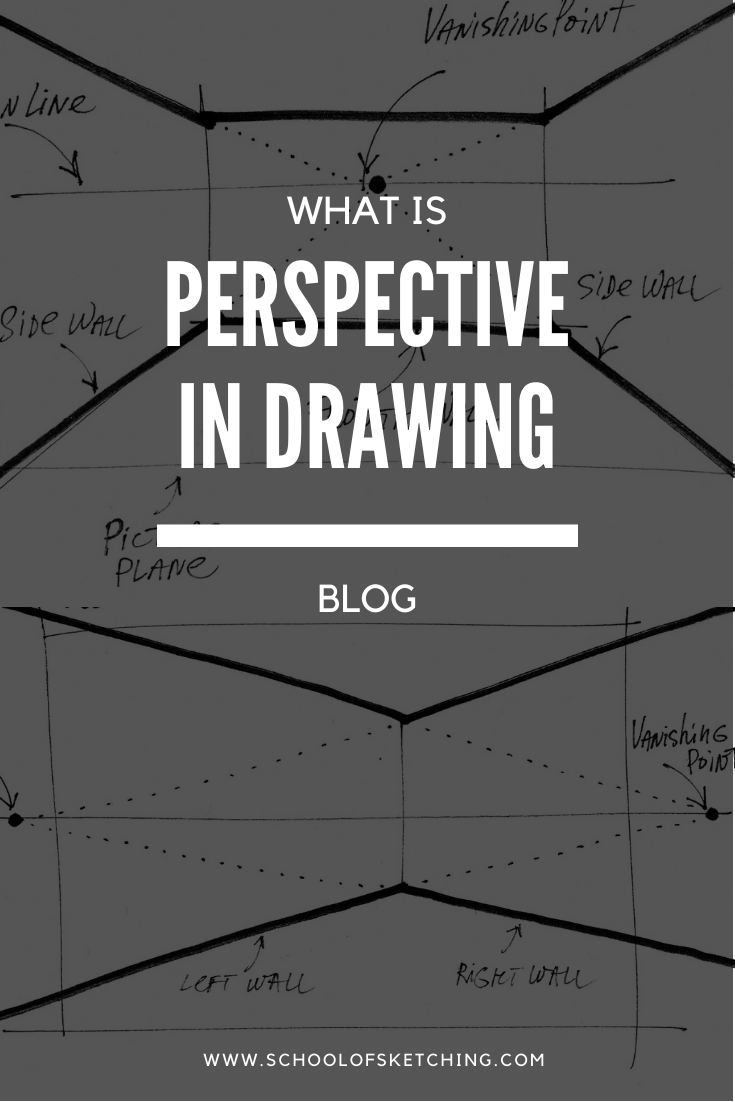
Here, nosotros will familiarize ourselves with the most extraordinary and most exciting field of descriptive geometry and will discover two main types of perspective – the about important skill in interior sketching.
Fundamentals/Basics
Perspective is an area of descriptive geometry. Non many people are slap-up on learning descriptive geometry at school, and for many, it is synonymous with tedious technical tasks and deadening routine. Perspective is an intriguing subject, full of surprising secrets, and is essential for interior designers. Information technology is this knowledge that volition permit you work wonders on paper, allowing you to create impressive views of interiors and to reflect your ideas in the nigh effective fashion.
Perspective is the basic and virtually fundamental knowledge for sketching. Information technology will assist yous deliver your projects expertly. Without information technology y'all will get nowhere – if you lot don't know the laws of perspective, and so you lack the foundations, which means yous cannot movement on, and no rendering technique or stylistic device volition assist you out if yous don't have a articulate agreement of how to plot a infinite. The center of a human being has an admirable organisation, and it is thanks to the laws of geometry that we tin can put down on paper or visualize the real world in the way our brain perceives it.
Types of perspective
What types of perspective are there, and which ones are of the most significant importance to interior sketching?
At that place are many types of perspective, to name but a few: aerial perspective, frontal perspective (or 1-point perspective), angular perspective (or two-points perspective or oblique view), perspectives with iii, four, five, and even vi vanishing points. So, which ones are of the greatest value to interior designers?
Commencement of all, it is the frontal perspective (information technology is sometimes called a perspective with ane vanishing point). Secondly, there is an oblique view or athwart perspective (with two vanishing points) and, finally, an aerial perspective (or tonal perspective). If the first two let united states to draw an interior correctly, the last 1 will enable you to fill your cartoon with air and convey 3-dimensionality of space. Once we master the nuts, we tin address more complex types of combined perspective – with iii vanishing points and various three-dimensional effects. Latest are heady perspective techniques that add together more expression to a drawing.
GET MY FREE PDF "MATERIALS FOR INTERIOR SKETCHING",
ENTER YOUR NAME AND E-mail HERE:
There is one artist that I desire to point your attending to whose mastery of perspective I particularly admire. I am talking about Dutch graphic artist Maurits C. Escher. His work is simply mind-boggling! My favourite is his boggling cocky-portrait (bank check it here), where he is drawing himself while looking in the mirror sphere, which besides reflects the interior. If you remove the ball, the room appears in a 1-point perspective; interestingly, the interior is reflected in the spherical mirror surface of the ball, it causes incredible furnishings and distortions of the space.
Escher's art is one of the brightest examples of mathematical laws of perspective, coupled with the author'south imagination. Escher published a book, "Incommunicable Worlds", where he plays with geometric rules, planes, creating inconceivable spaces. Scientists are well-versed in the beauty of mathematics, and Escher shows all of usa that dazzler.
"We admire chaos because we love to produce order. "
Once yous grasp the rules of construction of geometry of a space, yous can beginning experimenting with them. I call it 'playing with perspective'. All sketching masters have an excellent command of this cognition. So let'southward go going and discover it for ourselves!
1-Betoken Perspective (Frontal View)
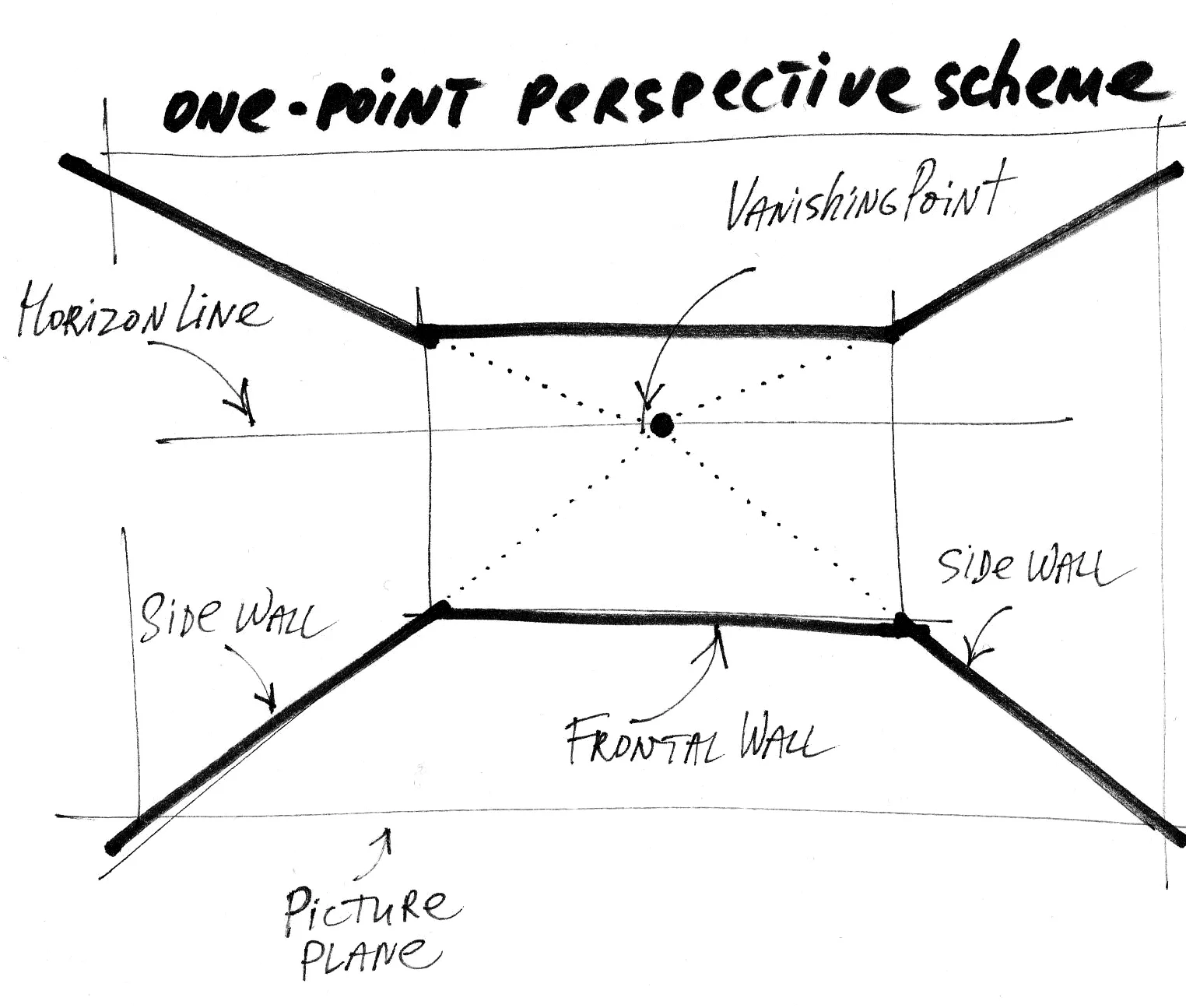
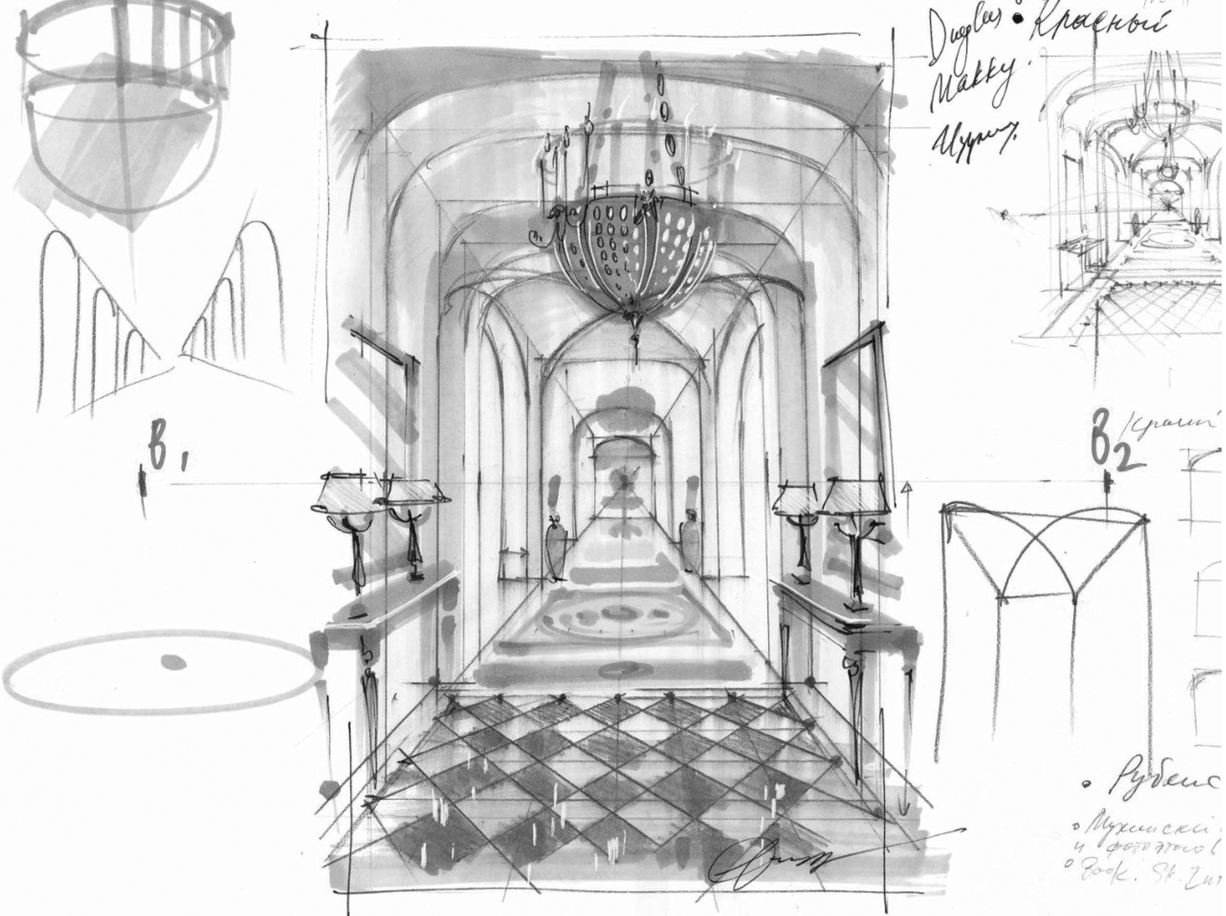
In this blazon of perspective, we have a vanishing signal, which is ever on the horizon line. This vanishing point is where all the lines converge to (that's why it is called a 1-bespeak perspective). When we draw an interior, we run into three walls: one that is parallel to the picture plane (frontal wall) and two side walls.
It is a linear perspective, and it comes into play when your line of sight is parallel to the horizontal ready of lines that converge upon a single point in the distance and perpendicular to the other set of lines in the view. Information technology is the simplest type of perspective because we deal with only one vanishing point.
We are forever indebted for this knowledge to the Italian Renaissance. In the second half of the XVth century, Renaissance artists and mathematicians adult the linear perspective theory and brought precision and mathematics into mainstream art. Viva Italia!
Earlier that, artists drew 'past eye' or used Inverted Perspective (Byzantine Perspective), which is an art form unique to pre-renaissance religious fine art and is total of embedded pregnant. Every bit an instance, wait at Andrey Rublev's "Trinity" and observe how the infinite appears flat and converges towards the viewer.
Thank you to Renaissance and its masters, who were not but prolific artists, sculptors, architects, but also biggy mathematicians, the laws of perspective were discovered. Brunelleschi, Alberti, Masaccio, Ghiberti, Piero della Francesca introduced the apply of perspective, and, in doing so, forever inverse further development of art.
Renaissance masters were so fluent in the complexities of geometric construction that they were able to utilize their knowledge of perspective to perform most complicated tasks and solve quite challenging problems. For case, painting of a ceiling of a dome has to take into business relationship a variety of factors: first, people await at frescos from below, which significantly alters their perception. They too had to take into account the curved shape of the dome and correct for distortions that arise. Autonomously from that, there is a host of technical aspects such as the erection of scaffolding, working at a high distance, temperature, humidity. In the case of frescos, the humidity levels are very high, as painting is performed over damp plaster). The frescos technique of mixing colours, a problem of lighting, and fifty-fifty the position of a painter's body, all these are challenging factors for a painter. For instance, Michelangelo almost completely lost his sight while painting the Sistine Chapel.
When should we use a 1-point perspective?
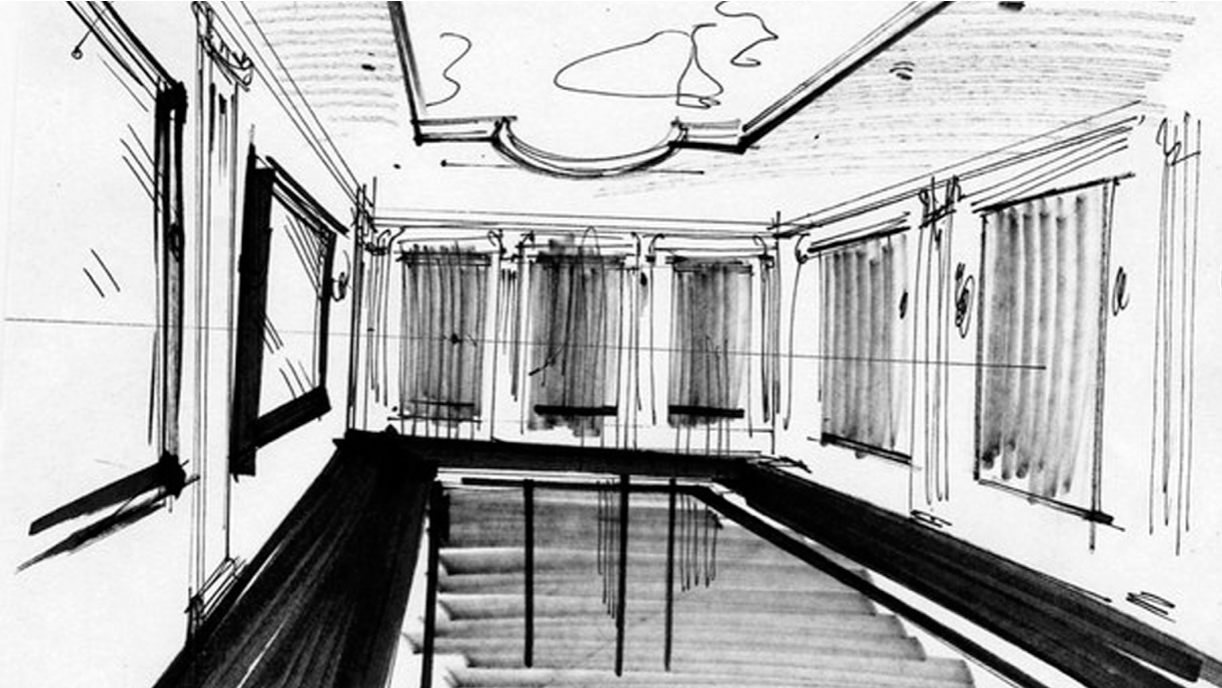
1-point perspective is an platonic choice for depicting public spaces: bars, cafes, restaurants, hotel lobbies, as well every bit spacious residential interiors: sitting rooms, dining rooms, halls, and lounges, etc. This view lets you lot represent your idea on a cartoon past showing the maximum amount of space. Suppose, nosotros have a restaurant layout, with a rectangular shell: it would be sufficient to depict two i-signal perspective views – in one direction as you enter and i in the opposite. If we were to utilise a 2-signal perspective view to demonstrate the design idea, we would take to draw all four corners of the infinite, plus a general view, a view from above, or even make a model (at least v sketches in total). In contrast, the i-point perspective view allows you to show the thought with simply 2 drawings.
We tin change the position of the vanishing bespeak in relation to the eye of the picture plane, placing it anywhere on the horizon line. It tin can be right in the centre, or it can be shifted to the right or to the left. This volition brand the picture asymmetric, which adds dynamism to the composition and allows you to reveal one of the walls to a greater extent. However, when the vanishing bespeak is correct in the centre, both walls are shown to the aforementioned degree, and, thus, appear balanced. Information technology is this placement of the vanishing point that is oftentimes used in classical drawings of interiors. Classics loves symmetry.
"Classics loves symmetry."
2-Point Perspective (Oblique View)
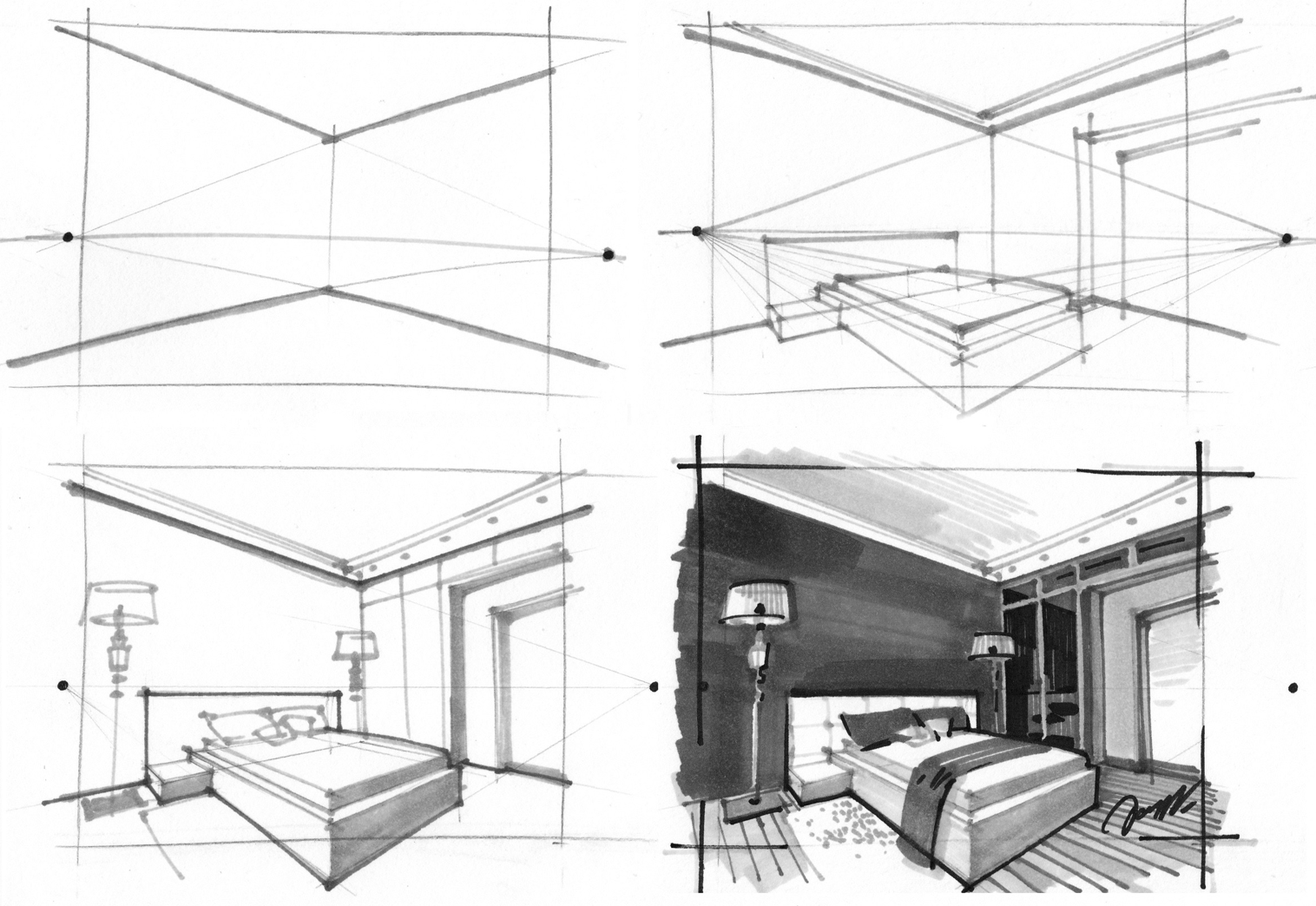
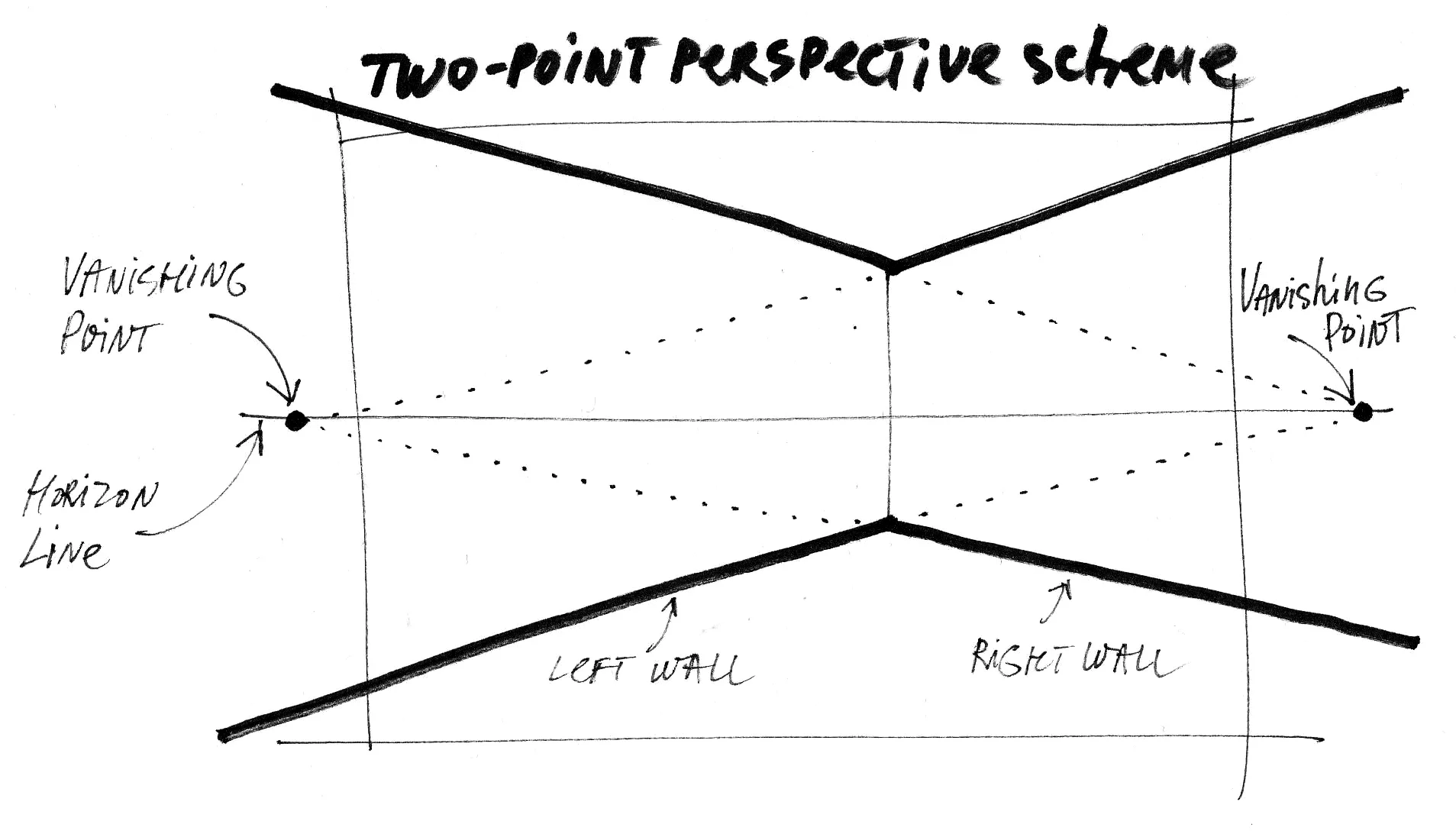
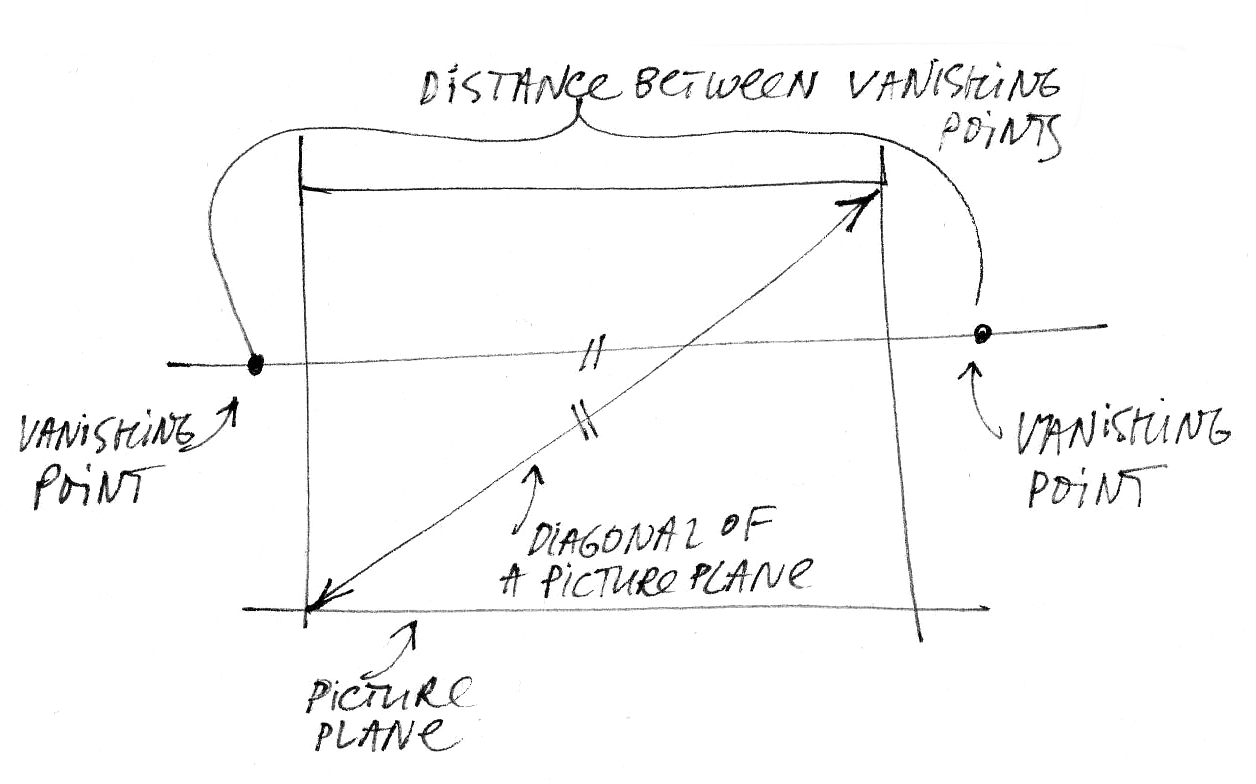
Some other type of perspective important for designers is the perspective with two vanishing points. It is often chosen an «Oblique View». In this view, the horizon contains two vanishing points, and the pic reveals two walls of a space. Y'all can move these points on the horizon line, but information technology is important that the distance between them should remain the same fixed value (usually this distance equals to the diagonal of the flick aeroplane). When you accept understood all the most critical basic laws of perspective, you will be able to experiment with them, creating drawings with the most constructive angles.
ii-point perspective is a linear perspective in which at that place are two vanishing points on the horizon line. This type of perspective appears when your line of sight is at an angle to the horizontal sets of lines that converge upon points in the distance. Simply said, you are at an angle to the wall. In a instance with a 1-betoken perspective, you face the frontal wall. That is why its second name is "frontal view", remember?
2-betoken is usually visually more than dynamic compare to 1-point because nosotros can run into the volumes of objects.
In which case 2-point perspective is the all-time option?
It is indispensable when nosotros want to show a infinite containing ane main object, a dominant characteristic. Easy example: in the bedroom, it is a bed; in the report, it is a desk; in the nursery, information technology is a cot. And so on.
This perspective is platonic for pocket-sized spaces, or when we desire to draw in detail a specific corner of an interior. Also, it is the oblique view that allows u.s. to show furnishings and other separate objects. I oft utilise it to specify upholstery. A flick is worth a m words, and it is way easier to send an image along with an club for a piece of furniture depicting exactly what I had in listen.
Resources
Read as well related articles on my blog:
-
"Top books on perspective drawing: my personal choice": here
-
"The vi principles of two-betoken perspective in interior sketching ": here
Larn more about perspective drawing in my volume "The SKETCH" (Amazon paper-based version or PDF).
Well, my creative friend, I promise you enjoyed this commodity, delight permit me know your thoughts on perspective drawing in the comments beneath. Is information technology a tricky subject field for you?
P.South. Please help me abound my weblog by sharing this article on your social media. Thank you in advance!
CHECK PROGRAM AND DRAWINGS FROM MY ONLINE COURSE ON INTERIOR SKETCHING WITH MARKERS FOR BEGINNERS "BASE".
A Course Which Teaches All the Basic Techniques You lot Need to Implement Sketching in Your Interior Design Practice:
Read other manufactures on the blog:
Source: https://schoolofsketching.com/blog-in-english/perspective
0 Response to "What Are the Different Drawing Perspectives of the Body Called"
Post a Comment